Over the summer, I had the opportunity to lead several workshops introducing newcomers and immigrants to Canada to the field of Health Informatics. I did this through Skills for Change and Newcomer Women’s Services Toronto, where I facilitated workshops for the Health Informatics Bridging Program, Pathways to Careers in Healthcare Data Analytics, and the Black Women in Data Analytics program.
There was a lot of great discussion from participants that I would like to share throughout this blog post
Before diving in, I want to let you know I will be running the last Sip and Share: Casual Health Informatics session. The focus of this session will be on revamping our resumes and connecting before the end of the year wraps up. This will take place on Saturday, November 7th, from 10:30 – 11:00 AM EST. You can sign up for this virtual community event here
Feedback from workshop participants:
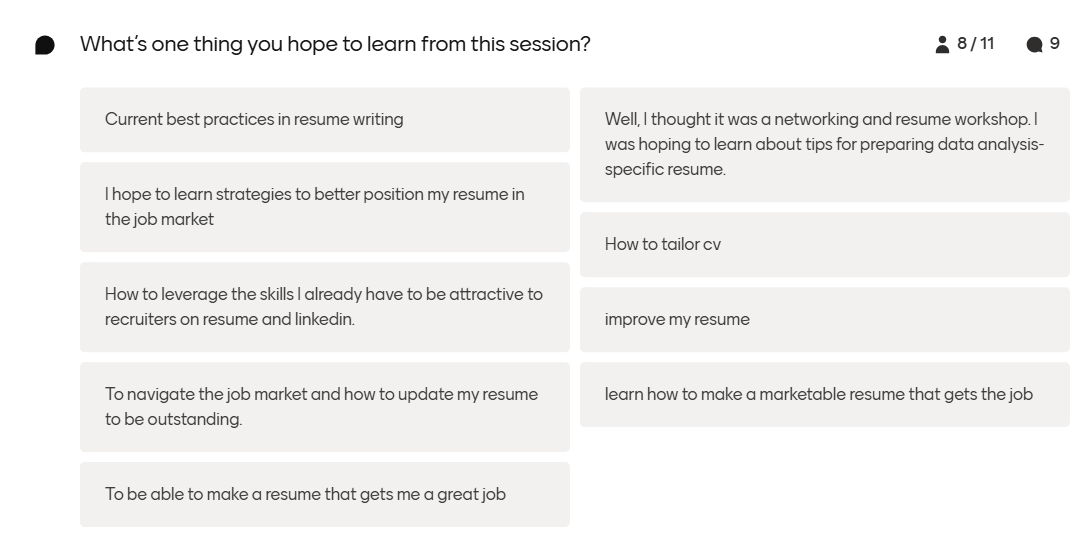
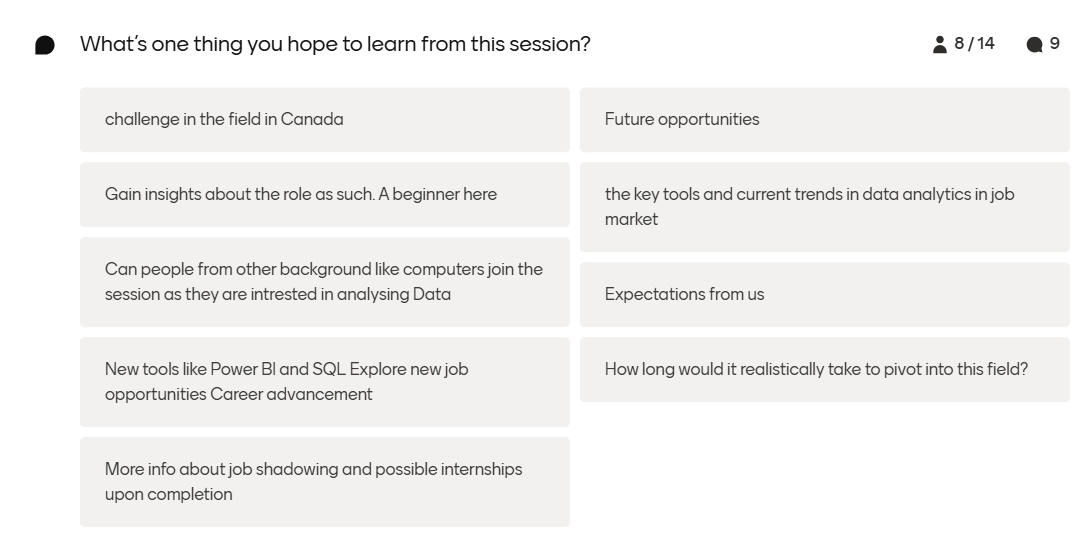
One theme I heard throughout the sessions I presented at was: How do I take the knowledge and skills I already have and use them to pivot into the health informatics field?
People expressed frustration about not being able to connect the dots between the skills they had acquired working in customer service roles or human resource roles to a role in the health informatics field. In some ways, I can relate to this as I also made a career pivot, this time last year, from an analytics role to a quality improvement role that I had little experience in. This brought up feelings of self-doubt and hesitancy.
However, there are areas where we can pull from to identify transferable skills. For example, for those who work(ed) in customer service, such as at a call centre, you might have resolved customer complaints or designed an intake form to document customer complaints. You might consider finding a way to apply an analytics lens to your current role by creating targets for yourself or finding digital solutions to resolving customer complaints (e.g., building a dashboard or chart in Excel or Power BI to create a centralized method to track metrics).
This can also help when re-structuring your resume to be a better fit for applying to jobs in the health informatics field
For example, in an accounting role you might have on your resume: “Generated weekly inventory reports for my manager.” You might consider translating that by highlighting technical tools you have experience in, such as Excel, to: “Automated weekly inventory reporting using Excel formulas and pivot tables, reducing manual prep time by 3 hours per week and enabling senior management to make faster restocking decisions.”
Another example might be for those who have previous experience working in a customer service role. ‘Tracked customer complaints in a spreadsheet” to “Used data cleansing methods to clean and categorize 500+ customer complaint records in Excel, identifying three root cause issues that led to a 15% drop in repeat complaints after the Quality Improvement team implemented fixes over the past fiscal year”
These tips can be helpful when structuring your resume for applying to health informatics roles. When it comes to the main body of your resume, make sure to use action verbs to highlight the work you have done. For instance, include examples of your work experience using quantitative data and highlight ways you made a significant difference over a specific time frame at an organization, either through working or volunteering.
If you’re looking to work through a portfolio project with a healthcare lens which you can link to in your resume and stand out to hiring managers, check out my course here, which can help you to advance your skills in Power BI and SQL.
Discount for newsletter readers (10% off using code: FALLSURGE, valid until October 29th 2026)
Another tip when structuring your resume is to use a quality improvement framework called the AIM statement to structure your resume bullet points into actionable results.
The AIM statement is a common Quality Improvement framework and consists of outlining:
- The specific measure which you have used in a job, volunteer or project role (e.g., # of customer complaints you resolved, etc.)
- The baseline data for that measure
- The target you or your team set to achieve for that measure
- The date by which that goal will be accomplished
If you have done work that has a specific baseline or target that you or your team tried to reach within a set timeline, this would be great to include in your resume.
I hope these tips are helpful to you when applying to jobs this fall. Remember, you don’t need to start from scratch! The work you have done previously is valuable and can be restructured to fit the health informatics role.
If you want to dive more deeply into these resume tips, don’t forget to sign up for the last Sip and Share: Casual Health Informatics session. At this session, I will expand more on the above. You can sign up for this virtual community event here
Here is a real-life example of someone who took the clinical knowledge and skills they already had to help them pivot into the field of health informatics. Please see below the interview I did with Jennifer Lewis, MSN-NI, BSN, RN, FC, who currently works as a Clinical Informatics Director. She started working as a nurse but was interested in the field of informatics. In her role as a nurse, she developed a centralized digital tool, which helped her to switch into her current field.
0 Comments